
ppc-management
Uncategorized

The Quiet Confidence of Not Explaining: Why Some Brands Let the Product Speak

Introduction: The Power of Restraint in a Loud Marketplace In today’s crowded marketplace, businesses often feel compelled to explain every feature, justify every price point, and articulate every benefit in exhaustive detail. However, a select group of brands has discovered a counterintuitive truth: sometimes, the most persuasive marketing says very little at all. Instead of over-explaining, these companies allow their products to communicate value on their own terms. Consequently, this approach, often described as quiet confidence, has emerged as a distinctive and increasingly respected marketing philosophy. Rather than overwhelming consumers with justification, brands that embrace this strategy trust their audience to recognize quality without excessive persuasion. This article examines why restraint often outperforms explanation, and how businesses can thoughtfully apply this principle to their own marketing efforts. The Psychology of Confidence Without Justification To understand why silence can be so persuasive, one must first examine how consumers interpret confidence. When a brand refrains from over-explaining its value, it implicitly signals self-assurance. Consumers often equate this restraint with quality, since they associate excessive justification with insecurity or desperation. Therefore, a brand that says less frequently appears to have more to offer. Moreover, this psychological dynamic taps into a broader human tendency to trust confidence over persuasion. People generally feel more drawn to individuals and brands that appear secure in their own worth, rather than those constantly seeking validation. As a result, when a company allows its product to stand without extensive explanation, it subtly communicates that the product’s value is self-evident, which in turn strengthens consumer trust. Why Over-Explaining Can Undermine a Brand Despite good intentions, excessive explanation often backfires in unexpected ways. When marketing copy attempts to justify every aspect of a product, it can inadvertently suggest that the product requires defense. Consequently, consumers may begin to question whether the product genuinely delivers on its promises, since so much effort has been invested in convincing them otherwise. In addition, over-explaining frequently overwhelms potential customers with unnecessary information, making decision-making more difficult rather than easier. Instead of simplifying the purchasing process, excessive detail can create confusion and hesitation. Therefore, brands that resist the urge to explain everything often find that their audience responds with greater clarity and confidence in their own purchasing decisions. The Role of Design in Silent Communication Design plays a crucial role in enabling brands to communicate without words. Clean, minimalist packaging, uncluttered websites, and simple visual identities often convey sophistication and quality more effectively than lengthy descriptions ever could. Furthermore, thoughtful design choices allow the product itself to become the primary storyteller, eliminating the need for excessive verbal justification. Additionally, this design-driven approach aligns closely with modern consumer preferences, particularly among audiences who value simplicity and authenticity over aggressive persuasion. When a product’s design communicates quality at a glance, customers form positive impressions almost instantaneously. Consequently, brands that invest heavily in design often reduce their reliance on lengthy marketing copy, allowing visual and sensory cues to do the persuasive work instead. Letting Product Experience Replace Persuasive Copy Beyond design, the actual experience of using a product often serves as the most convincing form of marketing available. Brands that prioritize exceptional functionality and usability frequently find that satisfied customers become their most effective advocates. Rather than relying on marketing claims, these companies allow firsthand experience to validate their value proposition. Subsequently, this experience-driven approach creates a natural cycle of trust. Customers who have a genuinely positive interaction with a product feel little need for additional convincing, and they often become enthusiastic promoters within their own social circles. Therefore, businesses that focus resources on product excellence rather than persuasive messaging often benefit from organic advocacy that traditional advertising simply cannot replicate. Case Studies of Brands That Let Products Speak Several well-known companies exemplify this philosophy of restrained communication. For instance, certain technology brands have built reputations around minimalist marketing, choosing sleek product demonstrations over lengthy technical explanations. Similarly, some fashion and lifestyle brands rely almost entirely on visual storytelling, allowing imagery to convey quality and aspiration without extensive written justification. Moreover, luxury automotive brands frequently employ this same principle, presenting their vehicles through evocative visuals and minimal text rather than detailed specification sheets. These examples illustrate that across diverse industries, allowing the product to communicate its own value can create a more powerful and memorable brand impression than exhaustive explanation ever could. Balancing Silence With Necessary Information While quiet confidence offers significant advantages, this strategy does not imply that businesses should withhold essential information entirely. Customers still require basic details necessary for informed decision-making, such as pricing, functionality, and practical use cases. Therefore, brands must carefully balance restraint with transparency to avoid leaving customers confused or uninformed. Nevertheless, the key distinction lies in eliminating unnecessary persuasion rather than essential clarity. Businesses should provide the information customers genuinely need while resisting the temptation to oversell or over-justify every detail. Consequently, successful implementation of this strategy requires a nuanced understanding of what information serves the customer versus what information merely serves the brand’s own insecurity. The Risks of Adopting a Minimalist Marketing Approach Despite its potential benefits, quiet confidence carries certain risks that businesses must carefully consider. Newer or lesser-known brands, for example, may struggle to build initial trust without sufficient explanation, since consumers often require context before recognizing genuine quality. Without established reputation or widespread recognition, excessive restraint can leave potential customers uncertain rather than intrigued. Additionally, this approach demands exceptional product quality, since there is little marketing language available to compensate for shortcomings. If the product itself fails to meet expectations, the absence of persuasive explanation offers no buffer to soften disappointment. Therefore, businesses considering this strategy must ensure their offering can genuinely withstand minimal marketing support before committing fully to this approach. Implementing Quiet Confidence in Your Own Marketing For businesses interested in adopting this philosophy, the process begins with a thorough evaluation of existing marketing materials to identify unnecessary justification or excessive detail. Subsequently, companies should focus on refining their product and design to ensure quality

content-marketing
Uncategorized

Selling the Problem, Not the Product: Why Pain Points Convert Better Than Features

Introduction: Shifting the Conversation From Features to Frustrations For decades, businesses have built marketing campaigns around product specifications, technical features, and innovative capabilities. However, a growing body of evidence suggests that this approach often fails to resonate with consumers on a meaningful level. Instead, the most persuasive marketing begins not with what a product does, but with the frustration, discomfort, or inconvenience it eliminates. Consequently, marketers have increasingly turned their attention toward identifying and articulating customer pain points before ever mentioning product specifications. This method, often referred to as problem-first selling, recognizes that people do not wake up thinking about features; rather, they wake up thinking about problems. By addressing those problems directly, brands create an emotional connection that specifications alone simply cannot achieve. Understanding the Psychology Behind Pain Point Marketing To appreciate why this approach works so effectively, one must first understand the psychological mechanisms at play. Human beings are naturally wired to avoid pain more urgently than they seek pleasure, a phenomenon often described as loss aversion. Therefore, when marketing messages highlight a problem the customer is currently experiencing, they trigger a stronger emotional response than messages that simply describe potential benefits. Furthermore, pain points create urgency. A customer who recognizes their own frustration reflected in a brand’s messaging feels understood, and this sense of being understood builds trust rapidly. As a result, the customer becomes more receptive to considering a solution, since the marketing has already validated their experience before asking them to make a purchase decision. Why Features Alone Fail to Persuade Despite the temptation to showcase every technical specification, feature-focused marketing frequently falls short in practice. Consumers, particularly those unfamiliar with technical jargon, often struggle to translate a list of features into tangible benefits for their own lives. Consequently, even an impressive feature set can leave potential customers confused rather than convinced. In addition, feature-based messaging tends to invite direct comparison with competitors, reducing the conversation to a battle of specifications rather than value. This dynamic often leads to price-based competition, since customers who evaluate products solely on features naturally gravitate toward whichever option offers the most for the least cost. By contrast, when marketing emphasizes the problem being solved, comparison shifts toward outcomes and experiences, areas where differentiation becomes far easier to establish. Identifying Genuine Customer Pain Points Before crafting problem-first messaging, businesses must first invest time in genuinely understanding their audience’s frustrations. This process typically begins with direct customer research, including surveys, interviews, and careful analysis of customer service inquiries. Through these channels, businesses can uncover recurring complaints and unmet needs that may not be immediately obvious. Moreover, social media platforms and online reviews offer valuable insight into unfiltered customer sentiment. By monitoring these conversations, marketers can identify language patterns that customers themselves use to describe their frustrations. Subsequently, this authentic language can be incorporated directly into marketing copy, creating messaging that feels remarkably personal and relevant to the target audience. Crafting Messaging That Speaks to Frustration Once genuine pain points have been identified, the next step involves translating that understanding into compelling messaging. Effective problem-first copy typically opens by naming the frustration explicitly, allowing the reader to immediately recognize their own experience within the message. This recognition creates an instant connection before the product itself is even introduced. Subsequently, the messaging should transition smoothly into presenting the product as a natural and logical solution to the previously described problem. Rather than listing features in isolation, each capability should be framed in terms of the relief or improvement it provides. Additionally, storytelling techniques can further strengthen this approach, since narratives that depict a customer overcoming a specific frustration tend to be more memorable and persuasive than straightforward feature descriptions. Case Examples of Pain Point Marketing in Action Numerous successful brands have built their entire marketing strategies around this problem-first philosophy. For instance, many software companies market their products by describing the inefficiency, frustration, or wasted time their tool eliminates, rather than focusing solely on technical capabilities. Similarly, financial services companies often emphasize the anxiety surrounding money management before introducing their specific tools or platforms. Additionally, consumer goods companies frequently use this technique by illustrating everyday frustrations, such as cluttered spaces or time-consuming chores, before presenting their product as the straightforward remedy. These examples demonstrate that regardless of industry, leading with the problem consistently proves more effective than leading with the solution’s technical merits. The Role of Emotional Language in Pain Point Selling Emotional language plays a critical role in reinforcing the effectiveness of problem-first marketing. Words that evoke frustration, exhaustion, or anxiety tend to resonate more deeply than neutral, technical terminology. Therefore, marketers should carefully select vocabulary that mirrors the emotional intensity of the customer’s actual experience. Nevertheless, this approach requires careful calibration, since excessive negativity can alienate potential customers rather than persuade them. Consequently, effective messaging balances acknowledgment of the problem with an optimistic transition toward resolution. This balance ensures that customers feel understood without becoming overwhelmed by negativity, ultimately guiding them toward a hopeful and actionable next step. Common Mistakes When Implementing This Strategy While problem-first marketing offers significant advantages, businesses often make critical errors when attempting to implement it. One common mistake involves exaggerating or fabricating pain points that do not genuinely reflect the target audience’s experience. Consequently, customers can quickly detect inauthentic messaging, which damages credibility rather than building trust. Additionally, some businesses fail to transition smoothly from problem to solution, leaving the messaging feeling incomplete or overly negative. Without a clear and confident presentation of the solution, customers may become more aware of their frustration without feeling motivated to take action. Therefore, marketers must ensure that every piece of problem-focused content ultimately leads toward a clear and compelling resolution. Measuring the Impact of Pain Point Marketing To determine whether problem-first messaging is genuinely effective, businesses should track specific performance indicators before and after implementation. Conversion rates, engagement metrics, and customer feedback all provide valuable insight into whether the new messaging resonates more strongly than previous feature-focused campaigns.

freelance-digital-marketer-in-thrissur
Uncategorized

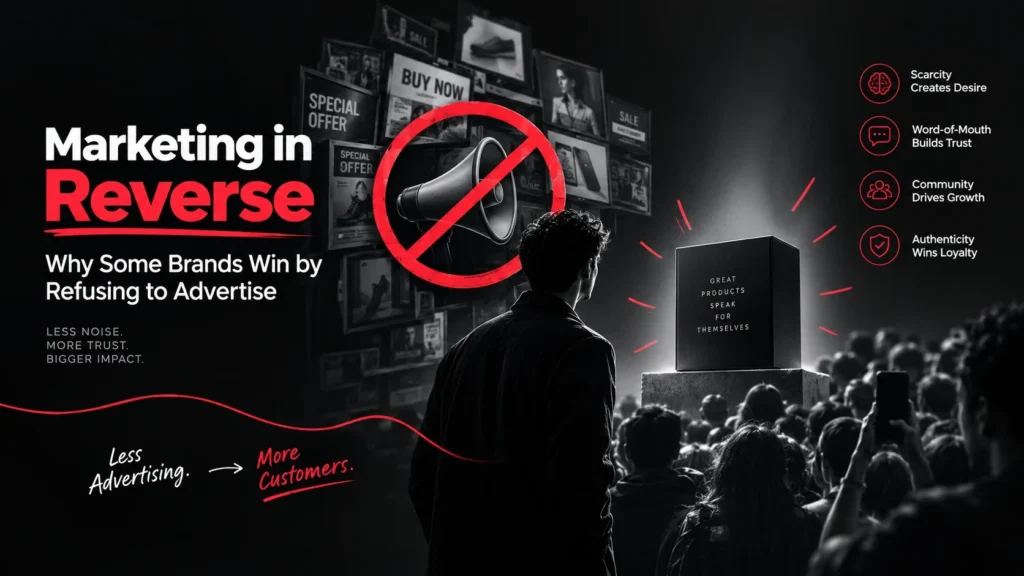
Marketing in Reverse: Why Some Brands Win by Refusing to Advertise

Introduction: The Quiet Rebellion Against Traditional Advertising In an era where advertisements bombard consumers at every digital turn, a curious phenomenon has emerged. Certain brands have chosen to abandon traditional advertising altogether, and remarkably, they continue to thrive. This approach, often described as marketing in reverse, challenges the long-held assumption that visibility must come from paid promotion. Instead, these companies rely on scarcity, word-of-mouth, and deliberate restraint to build demand. Consequently, marketers around the world have begun to question decades of conventional wisdom. If advertising drives sales, why do some of the most talked-about brands spend little to nothing on traditional campaigns? Furthermore, why do consumers seem more captivated by companies that refuse to sell to them directly? This article explores the mechanics behind this counterintuitive strategy and examines why refusing to advertise has become, ironically, one of the most effective marketing moves available today. The Psychology of Scarcity and Restraint To understand why silence can outperform noise, one must first examine the psychological principle of scarcity. When something is difficult to obtain, people naturally assign it greater value. Brands that limit their visibility create an implicit signal that they do not need to chase customers, which in turn makes those customers chase them instead. Moreover, restraint communicates confidence. A company that avoids aggressive advertising suggests that its product already speaks for itself. As a result, consumers begin to associate the brand with quality and exclusivity rather than desperation. This psychological shift transforms the customer’s role from a passive recipient of marketing messages into an active seeker of the product, which fundamentally alters the power dynamic between brand and buyer. Word-of-Mouth as the New Advertising Currency While traditional advertising broadcasts a message to the masses, word-of-mouth spreads through trust between individuals. Consequently, brands that refuse to advertise often invest heavily in creating experiences worth talking about. Instead of purchasing ad space, they focus on product excellence, customer service, and moments of surprise that naturally generate conversation. In addition, word-of-mouth carries a credibility that paid advertisements simply cannot replicate. When a friend or family member recommends a product, the endorsement feels authentic and unbiased. Therefore, brands that cultivate genuine enthusiasm among their existing customers effectively convert those customers into an unpaid, highly trusted sales force. This organic growth mechanism, though slower to build, tends to produce more loyal and long-term customers than traditional advertising ever could. Case Studies in Anti-Advertising Success Several well-known companies illustrate the power of this reverse marketing approach. For instance, some luxury brands intentionally limit their advertising spend, choosing instead to rely on exclusivity and limited product runs to generate demand. Similarly, certain technology companies have built massive followings primarily through product design and user experience rather than traditional commercials. Additionally, some direct-to-consumer startups have famously grown through referral programs and community engagement instead of paid media. These examples demonstrate that success without conventional advertising is not merely theoretical; it is a proven strategy across multiple industries. Nevertheless, this approach requires exceptional product quality, since there is no advertising budget to mask weaknesses in the offering itself. Building Trust Through Silence Interestingly, silence itself can function as a powerful marketing tool. When a brand refrains from constant self-promotion, it avoids the fatigue that often accompanies aggressive advertising campaigns. Consumers today are increasingly skeptical of overt sales pitches, and therefore, a brand’s willingness to stay quiet can be interpreted as a mark of integrity. Furthermore, silence creates space for curiosity. Rather than telling consumers what to think, brands that avoid heavy advertising allow their audience to form organic opinions based on genuine experience. This approach fosters a deeper, more authentic relationship between the brand and its customers, since trust is earned through demonstrated value rather than repeated persuasion. The Role of Community in Reverse Marketing Communities often replace traditional marketing channels for brands that reject conventional advertising. Instead of purchasing ad placements, these companies invest in creating spaces where customers can connect, share experiences, and advocate for the brand collectively. As a result, the community itself becomes a self-sustaining marketing engine. Moreover, community-driven marketing tends to produce higher engagement rates than traditional advertising, since participants feel a sense of ownership and belonging. Consequently, members are more likely to defend the brand publicly, recommend it to others, and remain loyal even when competitors offer lower prices. This dynamic illustrates how relationships, rather than transactions, can become the foundation of sustainable business growth. Risks and Limitations of Refusing to Advertise Despite its apparent advantages, marketing in reverse is not without risk. Smaller or newer brands, for example, may struggle to build initial awareness without any paid promotion. Without a baseline of visibility, even an exceptional product can remain undiscovered by potential customers who might otherwise become loyal advocates. Additionally, this strategy demands patience, since organic growth typically unfolds more slowly than paid campaigns. Businesses that rely solely on word-of-mouth must be prepared for extended timelines before seeing meaningful returns. Therefore, companies considering this approach should carefully evaluate their financial runway and market position before abandoning traditional advertising entirely. How to Implement a Reverse Marketing Strategy For brands interested in adopting this approach, the first step involves prioritizing product quality above all else. Since there is no advertising budget to compensate for shortcomings, the product or service itself must consistently exceed customer expectations. Otherwise, the entire strategy collapses under its own weight. Subsequently, businesses should focus on cultivating relationships with early adopters and encouraging authentic reviews and testimonials. By nurturing a small but passionate customer base, brands can create the initial momentum necessary for organic growth to take hold. Additionally, transparency and consistent communication, even without traditional advertising, help maintain trust as the brand scales. The Future of Anti-Advertising Marketing Looking ahead, it seems likely that more brands will experiment with reduced advertising in favor of authenticity-driven strategies. As consumers become increasingly resistant to traditional sales tactics, companies that prioritize genuine value and community engagement may find themselves better positioned for long-term success. Nevertheless, this does not necessarily signal the

Scroll to Top